Real-time imaging and sensing: where performance can’t wait.
Defined by signal quality. Enabled by materials. Built on glass.
The “power of now” is the moment when imaging and sensing systems must deliver not just fast signals, but high accuracy and reliable information — without delay, correction, or second chances.
Real-time performance is rarely limited by software or processing speed. It is determined much earlier, by signal-to-noise ratio, sensitivity, optical precision and material stability – factors embedded deep within the system.
Real-time imaging and sensing start before the signal
Real-time imaging and sensing describe a system’s ability to perceive and respond with precision exactly when information is needed. In applications like automotive interior sensing, driver monitoring, advanced driver assistance, mobile authentication, and industrial perception, meaningful performance depends on one thing: the quality of the captured signal.
Once optical or mechanical information degraded, no amount of downstream processing can fully restore it. System performance is shaped by physical limits: including optical homogeneity, thermal expansion behavior, mechanical stability, and long-term material integrity.
At its core, reliable real-time performance depends on material-defined system behavior — and on glass-based platforms that convert physical principles into stable, high-quality signals.
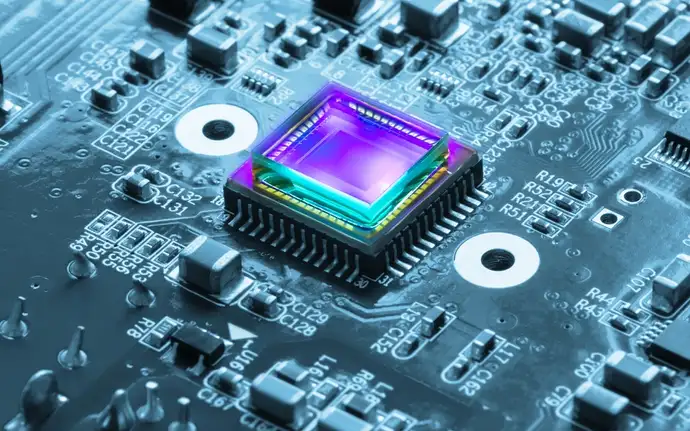
Beyond speed: the role of signal quality and sensitivity
Real-time performance is often equated with processing speed or latency. In reality, it is defined much earlier, during the design phase, by signal quality, sensitivity, and stability.
Even small physical deviations can disproportionately impact sensing performance:
- Surface deviations and material inhomogeneity distort optical paths and reduce signal-to-noise ratios.
- Mechanical stress and aging increase noise and drift, silently eroding sensitivity over time.
- Thermal expansion mismatches create micro-misalignments that compromise signal fidelity.
These factors determine whether meaningful information can be captured at all.
Core system requirements for imaging and sensing
High-performance imaging and sensing systems demand precisely controlled material properties that enable signal quality, stability and reliability — forming the physical foundation for consistent system behavior across sensing domains.
Mission-critical imaging and sensing
In mission-critical environments, imaging and sensing systems operate close to their physical limits. High sensitivity and reliable signal integrity are essential, placing strict demands on material quality and system stability.

Mobile sensing
Mobile sensing enables face authentication, biometric access control, and 3D depth perception. Performance must remain consistent across millions of devices, without compromising sensitivity or signal consistency.
Key applications
- Face authentication and biometrics
- 3D sensing and depth perception
- Scalable sensing systems

Automotive sensing
Automotive sensing systems – including in-cabin sensing, driver monitoring, ADAS and LiDAR – must maintain accuracy over long lifetimes, despite vibration, temperature variations, and regulatory constraints.
Key applications
- In-cabin sensing and driver monitoring
- Environmental perception and ADAS
- LiDAR
- Long-term reliability and compliance
Core sensing and system domains
Sensing Vision combines material expertise and system understanding across complementary sensing domains.

Imaging systems
Optical sensing performance is defined before the first pixel is captured. Once degraded, optical information cannot be fully restored downstream.

Pressure sensing
Pressure sensing systems rarely fail suddenly. Instead, they degrade gradually as materials deform, age, or drift under mechanical and thermal stress.
System and enablement and integration
High sensitivity in imaging and sensing systems cannot be achieved through signal processing alone. It depends on how well materials, structures, and integration technologies preserve signal quality throughout the entire system.
Wafer-level optics (WLO)
Challenges
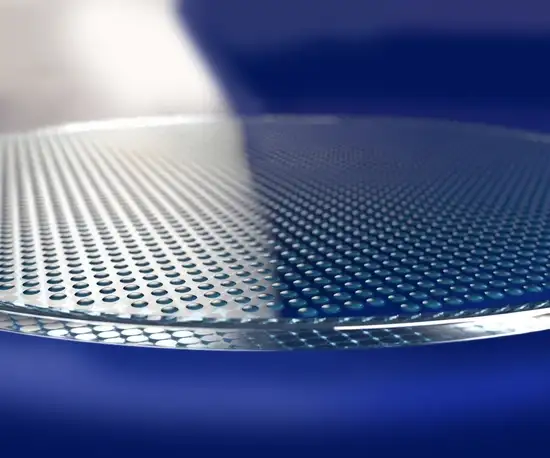
- Wafer-level TTV (Total Thickness Variation) and warpage shift focus across sensor arrays.
- Micro-misalignments degrade signal quality and reduce sensitivity.
Glass substrates with controlled planarity, low warpage, and defined thermal behavior preserve optical paths at scale, enabling compact, high precision systems with stable, reproducible signal quality.
Nanoimprint lithography

Challenges
- Nanometer-scale fidelity across entire wafers.
- Surface defects and inhomogeneities directly affect optical performance.
- Thermal and mechanical stress alter nanoscale features over time.
Glass substrates provide the surface quality, planarity, and dimensional stability needed to keep nanoscale structures optically functional under real-world conditions.
Metalenses

Challenges
- Extreme sensitivity to surface quality and optical homogeneity.
- Thermal expansion impacts phase response.
- Long-term stability without focus drift or performance degradation.
Glass substrates offer thermal stability, optical homogeneity, and dimensional control required to translate metasurface designs into predictable optical behavior.
Why glass matters in imaging and sensing
Imaging and sensing systems rarely fail due to software alone. They fail when physical limits degrade signal quality, sensitivity and stability. Material properties define thermal stability, mechanical integrity, surface quality, and chemical resistance – all of which influence alignment, signal integrity, and long-term performance.
Glass material platforms for high-sensitivity imaging and sensing
High-performance systems do not rely on a single material property, but on glass compositions engineered to control thermal, mechanical, optical, and chemical behavior at the system level.
In high sensitivity architectures, material behavior directly defines signal quality. Small variations in thickness, homogeneity, or thermal expansion lead to misalignment, noise, and drift – issues that cannot be corrected later.
For more than 140 years, SCHOTT has developed specialty glass materials at the intersection of material science, precision processing, and system requirements. Glass is not just a passive carrier – it actively defines optical stability, mechanical behavior, and long-term reliability in imaging and sensing systems.
Material properties that define signal quality and system stability
SCHOTT specialty thin glass enables high-sensitivity imaging and sensing systems by preserving signal integrity and stable system behavior:




Why glass enables stable sensing performance
While polymers scale easily but introduce thermal drift and aging effects, and silicon integrates well electronically but imposes optical and packaging constraints, glass delivers precision, stability, and scalability – making it a functional contributor to imaging and sensing performance. Unlike alternatives, glass maintains its properties under real-world conditions, ensuring long-term consistency without compromising optical or mechanical performance.
D 263® T
Designed for high-precision optical systems and wafer-level integration, where thickness control and surface quality directly impact performance.Its low TTV and excellent surface properties enable high-fidelity replication and stable optical behavior across high-volume production.

AF 32®
Engineered for thermally demanding environments and integrated optical stacks, where alignment stability is critical. Its low coefficient of thermal expansion and optical homogeneity ensure consistent performance under temperature cycling and long-term operation.

BOROFLOAT® 33
Robust glass for demanding sensing environments, offering high transmission from UVA to VIS and NIR. BOROFLOAT® combines excellent optical clarity with strong chemical and mechanical resistance, an optimized coefficient of thermal expansion, and a broad thickness portfolio. Its consistent quality and reliable availability ensure stable performance and long-term precision under challenging conditions.

From material expertise to trusted development partnership
Developing high-performance imaging and sensing systems requires more than material selection. It demands a partner who understands system requirements and translates them into material behavior across the entire lifecycle.
SCHOTT supports sensing projects from early design to scalable production, focusing on predictability, stability, and long-term reliability. System performance is defined long before a system is activated – this is where material expertise becomes a trusted partnership.
Extending high-sensitivity principles across applications
The principles above apply beyond automotive and mobile systems. Wherever machines interpret physical signals, sensitivity, signal integrity, and material stability define performance. The same constraints apply across diverse sensing architectures:


Discuss your sensing challenge
From wafer-level optics to advanced glass substrates, our experts help translate system requirements into reliable material solutions for imaging and sensing.