Unum: Improving business class seat reliability and comfort

Reliably comfortable. Responsibly made. Unum’s mission is very powerful. Please break it down and explain its elements?
The comfort side of things is the starting position. Ask the passenger and they will have an opinion, but ask the seat and it will never answer you. Therefore, comfort is experiential. In our mission, we say that we enable comfort for the passenger, so the products that we create must have that enablement.
In terms of reliability, the key factor in business class is on-time delivery. Many programs run late and run over. While some of that may still be COVID-impacted, nevertheless, the business class sector doesn’t have the greatest reputation for on-time delivery. Thus, it's not just enough to say you're going to deliver on time. You have to have credible evidence.
We at Unum demonstrate that by running short, localized and thus agile supply chains. We rely on the expertise that exists around us in the UK and in Europe, including our friends at SCHOTT. This was devised as part of our integrated design and manufacturing strategy. That drives reliability throughout everything we do on the production side of the business.
The second aspect of our reliability focuses on our customers. Our products are easy to maintain. We have to support our seats for their flying life of up to 15 years with spares, upgrades and through heavy check periods. The key mechanisms can be changed out on wing in less than five minutes, including the seat and the table. The philosophy we have is like our friends from automative would say: “you don't have to take the engine out to change the clutch”.
Let’s look at the second part of your mission, “Responsibly made”.
We have an obligation to our planet on our journey to net zero in 2050, so for us, it means designing a lighter weight seat. We have done a lot of work on sustainability. Our colleagues at Airbus and Boeing agree that lighter weight is the single biggest contribution any seat manufacturer can make, because that product requires fuel to be carried around. We at Unum have the lightest weight herringbone seat available on the marketplace today.
Secondly, we want the components that we choose for our seats to have less embedded carbon. For example, if you choose to buy aluminum made from fossil fuel sources, the amount of embedded carbon is significantly higher than if you choose to source aluminum from renewable energy sources. We are happy to take these choices, and it is one of the reasons why we were the first airline seat manufacturer to join the Green Cabin Alliance.
What distinguishes Unum on the market?
The number one thing that we have, but nobody else does, is capacity. Currently, we are facing a business class supply chain crisis: the industry is desperate for additional capacity, and shorter manufacture lead times. There are a significant number of airlines with smaller widebody fleets including business class. They are underserved, getting no bed [i.e. lie-flat seats], yet they want to improve the product, bring it up to the latest generation, and enjoy the benefits of better technology, lighter weight and higher comfort.
The global fleet is growing steadily. The total number of aircraft flying will double in the next 20 years. And there are issues and delays amongst especially the widebody fleets, with both OEMS facing production constraints, meaning that their huge order books are stretching out five years and beyond. Therefore, airlines will require to keep their widebody aircraft longer and will need to upgrade the interiors. In the midst of this capacity bottleneck, we have a great, certified product and we have the much-needed factory capacity to produce lots of seats. We’re building a steady production pipeline for the next five to ten years.
How do you envision the future of flying in terms of passenger experience?
Let’s look back to the early 2000s, there was tremendous innovation in business class as the first lie-flat seats had started to take shape. That momentum of innovation has continued, though the pace has slowed. Today, the industry has settled down to two basic business class layouts: herringbone and forward- or staggered forward-facing. In addition, direct aisle access and doors have become must-have features. It’s often said that business class has become the new first class while premium economy now fills the role business class once did.
What does that tell us? There is a greater surge towards luxury, because today’s business class is much bigger than first class was 20 years ago. First class still exists with highly bespoke, customized products, but very limited seat numbers. We are also seeing greater segmentation across the whole cabin. Some airlines now ask for super business class front rows with more space and elevated experiences. We are also at an interesting moment across premium economy and economy, with a greater product segmentation to offer passengers more choice.
Looking ahead, we have arrived in lie-flat bed territory with narrowbodies, as single-aisle aircraft now fly six- to seven-hour routes, such as transatlantics. Suddenly there's a whole world of routes opening up: new secondary city pairings. This makes consistent product quality across widebody and narrowbody fleets more important than ever, as passengers expect the same experience in the class they booked regardless of aircraft type.
What is special about your product range and how does it allow you to realize your vision of best passenger experience?
Our Scimitar seat mechanism is our comfort hero, offering inifinite adjustment and super Zero G for the passenger. . There is a question you get asked in the industry, which is, ‘what is the most comfortable position?’ And the answer is ‘the next one’, because we are motive human beings: we move, we wriggle, even when we’re asleep. With our mechanism, you can start to make micro adjustments, go into this fantastic Zero-G position that our seat enables. Our architecture makes that seat mechanism available for all of our products, allowing us to offer consistency of comfort across all of our seats in all airlines. We have been reassured by great customer feedback.
Additionally, our products are lighter weight than any other business class herringbone layout, which we enable thanks to simplicity in design. But, lighter weight alone does not sell the seat – a luxurious and refined experience does. Weight is by far the biggest bonus.
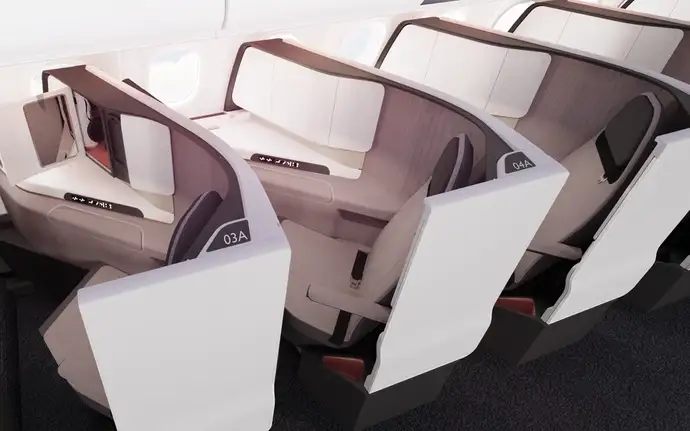
Unums first product, Unum One, is a herringbone layout, available for delivery from 2026.
What role does light play within the aircraft and how does it enhance passenger experience?
Lighting in the business class suite can be broken down into two elements. Functionality and experiential comfort. Functionality and great design go hand-in-hand in business class. In addition, lighting is also experiential, it creates ambience, and can even have some smartness to it. For example, if you get up during the night, the lighting comes on and illuminates your way to the bathroom, but doesn't wake up your traveling companion. That is what we have to get across to business class: Experiential lighting creates ambience and allows the passenger to control their circadian rhythm. At the end of the day, light strongly contributes to making the passenger comfortable.
What inspires you personally for your work and why do you enjoy working in the aviation industry?
I’ve spent over a decade in airline in-flight services, working on everything from meals to IFE and seating – essentially, the passenger experience. One of the greatest moments was seeing a passenger post on Facebook that the best meal they ever had was one I developed. That’s the kind of impact that drives me.
In my heart, I’m a problem solver. Airlines have faced the same fundamental challenges in the last 30 years, like optimizing cabin layouts or delivering a great onboard product, and I take pride in finding smart solutions.
Travel is also a big part of what fuels me. I’ve worked for startups where economy class travel was the norm, and I’ve enjoyed every part of it. I’ve visited 62 countries so far, and nothing beats face-to-face connection – whether it's meeting customers or catching up with old friends and colleagues around the world. Working in aviation is hugely rewarding.
Text: Dr. Haike Frank, SCHOTT
Photos: Unum Aircraft Seating
Sept 2025
Link
More information on Unum Aircraft Seating