LISA Pathfinder – Enabling the future of gravitational wave astronomy
What if we could listen to the universe itself? With the LISA Pathfinder mission, the European Space Agency took a decisive step toward making that vision a reality—paving the way for the first space-based observatory of gravitational waves. At the heart of this pioneering mission: ZERODUR® glass-ceramic from SCHOTT, enabling unprecedented optical stability in the harshest conditions. Discover how ultra-precision materials are helping science reach new frontiers.Key features
Searching for gravitational waves
The European Space Agency’s LISA Pathfinder mission, launched on December 3, 2015, was a pivotal milestone in advancing the direct detection of gravitational waves—subtle distortions in spacetime predicted by Einstein’s theory of general relativity. These waves, generated by events such as black hole mergers, produce effects on the order of 10⁻²¹, requiring extraordinary precision to observe.
To validate the core technologies for future space-based gravitational wave observatories, ESA designed LISA Pathfinder as a precursor to the more ambitious Laser Interferometer Space Antenna (LISA) mission. LISA will consist of three spacecraft arranged in a triangular formation, separated by 2.5 million kilometers, capable of detecting low-frequency gravitational waves that ground-based detectors cannot access.
Achieving sub-picometer stability amid launch stresses
The primary objective of LISA Pathfinder was to demonstrate the ability to control and monitor two free-floating test masses with sub-picometer precision—essentially ensuring that they remain in near-perfect free fall. To achieve this, the mission employed a laser interferometer system mounted on an optical bench with extreme dimensional stability. In addition to providing this measurement fidelity in orbit, all components had to withstand the mechanical stresses of launch, including vibrational accelerations up to 20 g. These dual requirements—optical precision and structural robustness—placed exceptional demands on the materials used in the spacecraft’s payload.Ultra-stable support for the search for gravitational waves
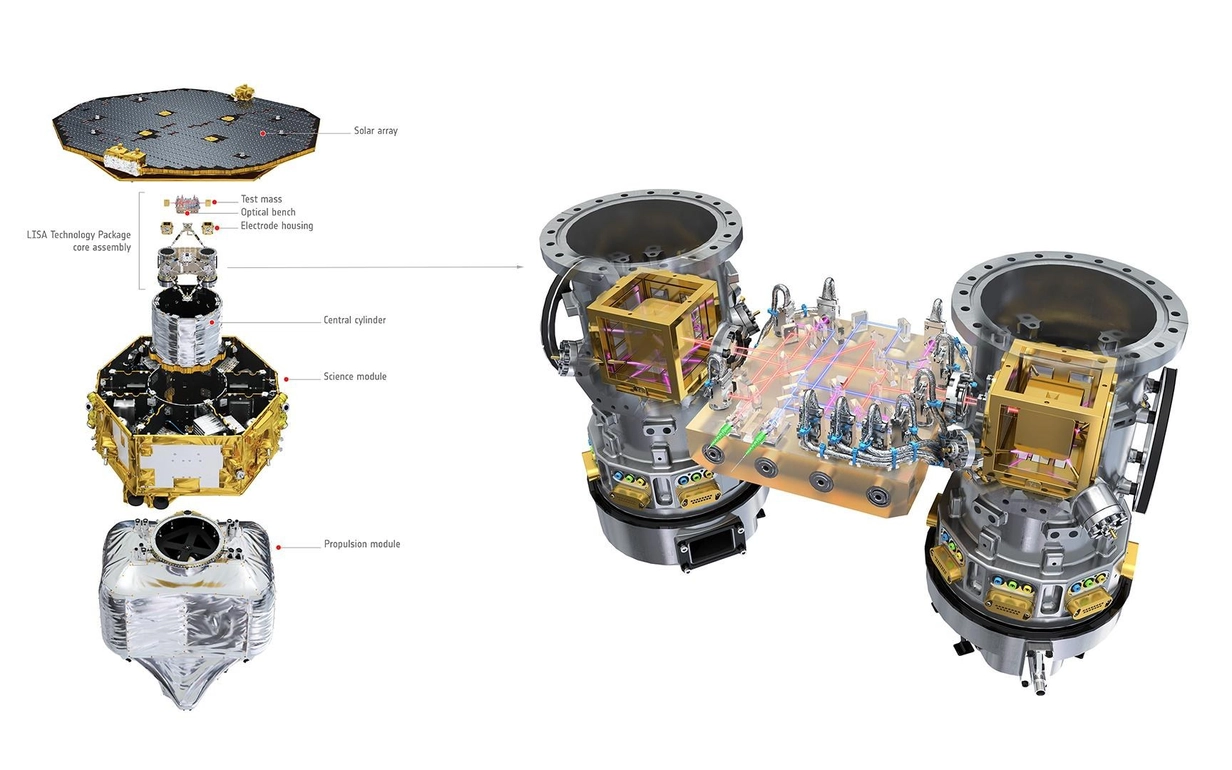
The optical measurement system of LISA Pathfinder – the LISA Technology Package (LTP) – includes two gold-platinum test masses, each surrounded by an “electrode housing” inside compact vacuum chambers within the mission’s science module. Positioned between the test masses (38 centimeters apart) is the optical bench of the laser interferometer. Credit: ESA/ATG medialab

LISA Pathfinder flight optical bench during construction. Credit: University of Glasgow

The Flight Optical Bench ready for integration into the LISA Pathfinder Technology Package. Credit: University of Glasgow and University of Birmingham
Material used
Key partners and their roles in the LISA pathfinder mission
The success of the LISA Pathfinder mission was made possible by close collaboration between leading space agencies, research institutes, and industry partners, each contributing their unique expertise:
- European Space Agency (ESA)
As the mission owner and coordinator, ESA oversaw the entire project lifecycle—from mission design and funding to launch and operations. - Airbus Defence and Space (formerly EADS Astrium)
Served as the prime contractor, responsible for the spacecraft bus, integration, and ensuring the payload met stringent spaceflight requirements. - Max Planck Institute for Gravitational Physics (Albert Einstein Institute), Germany
Developed the mission’s core scientific instruments, including the ultra-precise optical metrology system crucial for measuring gravitational waves. - CNES (French Space Agency)
Delivered the Gravity Reference Sensor and other payload components essential for maintaining test masses in free fall. - OHB System AG
Contributed key spacecraft subsystems and support for payload integration. - SCHOTT AG
Supplied ZERODUR®, the ultra-stable glass-ceramic material used for the optical bench and test mass housings, ensuring thermal and mechanical stability in space.
This collaborative effort enabled LISA Pathfinder to validate the cutting-edge technologies needed to open a new window on the universe through gravitational wave astronomy.