Technical details of SCHOTT® Luminous Laser Diffusers
SCHOTT® Luminous Diffusers offer superior laser delivery solutions for demanding applications due to the outstanding technical properties and characteristics of their raw materials. As a company that’s looking to form strong partnerships, we can tailor those qualities for a bespoke solution.
A new generation of laser delivery systems
Scattering profiles
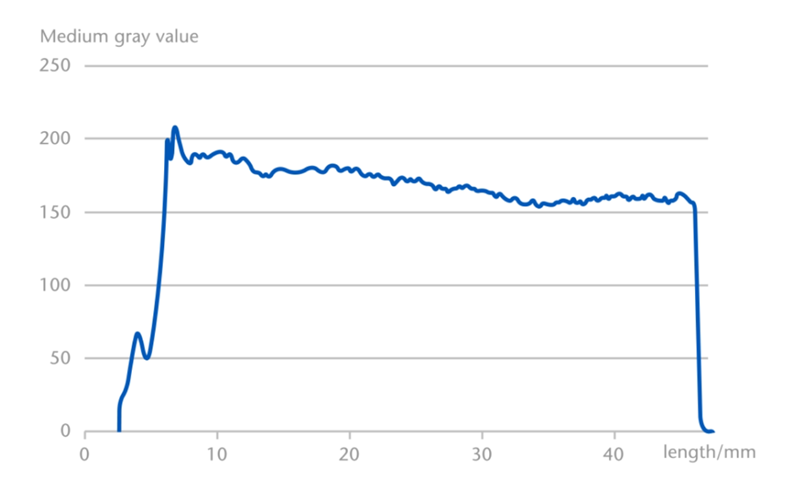
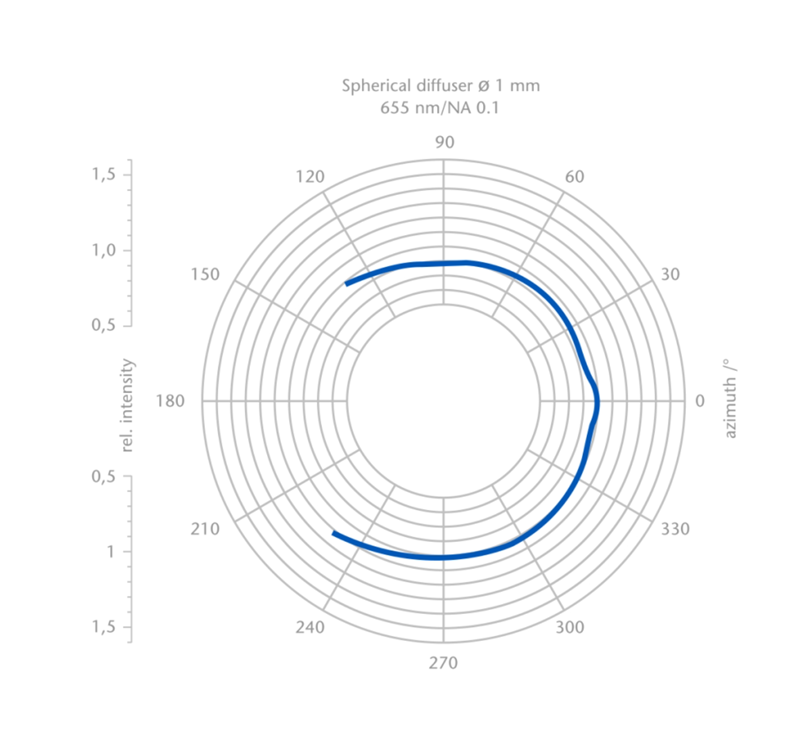
Compared to bare fiber tips, laser diffusers enable controlled light scattering and uniform irradiance distribution, reducing local hot spots and improving treatment consistency. The radiation profiles shown illustrate typical light‑distribution characteristics of SCHOTT® Luminous cylindrical and spherical diffusers. These profiles demonstrate the homogeneous emission patterns achievable along the diffuser length or around the distal tip, as well as the reproducibility of optical performance across different diffuser configurations.
SCHOTT® Luminous Cylindrical Diffusers
Radiation profile (homogeneity).
SCHOTT® Luminous Spherical Diffusers
360° radiation profile (homogeneity).

FAQs
A laser fiber diffuser is an optical component that converts a laser beam into a controlled, homogeneous light distribution. Depending on the geometry, light is emitted radially along a defined diffuser length (cylindrical diffuser), isotropically from the tip (spherical diffuser), forward with controlled beam shaping (front-emitting diffuser), or in a customized shape. Laser fiber diffusers are used for uniform, homogeneous illumination in minimally invasive, intracavitary, and surface-based medical treatments.
Light distribution is achieved through controlled scattering within the diffuser, enabling defined angular emission profiles and uniform irradiance across the treatment zone.
Cylindrical diffusers emit light radially along a defined length and are used for uniform illumination over extended regions. Spherical diffusers emit light isotropically in 360° and are used for point-source illumination inside cavities or tissues.
Yes. Laser diffusers are commonly integrated into minimally invasive medical devices for intracavitary, interstitial, and endoluminal light delivery.
Typical applications include photodynamic therapy (PDT), photoimmunotherapy (PIT), laser interstitial thermal therapy (LITT), antimicrobial PDT (aPDT), and endovenous laser treatment (EVLT).
Diffuser dimensions depend on geometry. Cylindrical diffusers typically range from a few millimeters up to several centimeters in length, while spherical diffuser tips are typically in the sub-millimeter to millimeter range.
Key selection parameters for laser diffusers include: Emission geometry (radial, isotropic, or forward), diffuser length or emission area, wavelength compatibility (visible to NIR), power density and thermal behavior, and integration constraints such as fiber diameter and routing.