Does this match your preferences? Make a selection.
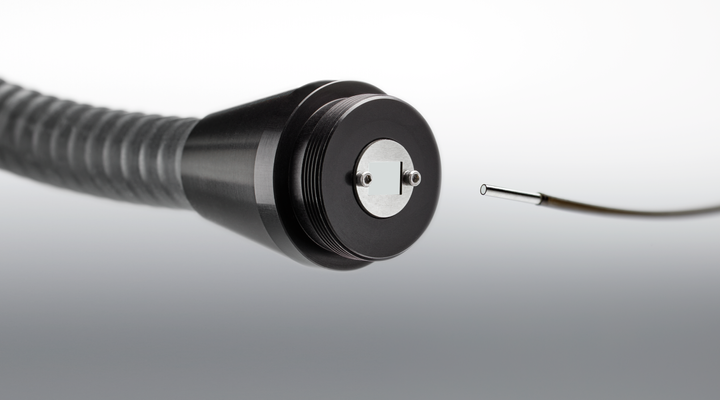
Close-up of SCHOTT flexible fiber optic imaging bundles with C-mount and thin distal end for high-resolution image transmission in confined spaces.

Flexible imaging bundles

SCHOTT® flexible imaging bundles offer an imaging solution for environments where conventional electronic systems fail or cannot operate. Designed for harsh environments, confined spaces, and power-restricted areas, these passive, flexible fiber optic bundles transfer images over distance, even without a direct line of sight, in both active and passive scenarios. Proven across medical, industrial, defense, aviation and space applications, they combine precision, durability, and modular design for mission-critical performance.

SCHOTT large diameter flexible fiber optic imaging bundle with end connectors, designed for image transfer in medical, industrial, defense and aviation applications.

Passive imaging for challenging conditions

SCHOTT® image guides operate where electronics cannot, delivering EMI-proof imaging without power. They enable visibility in harsh environments exposed to pressure, shock, heat, radiation, and electromagnetic interference, enabling safe and reliable performance in critical applications.
SCHOTT small diameter flexible fiber optic imaging bundles for precision imaging in confined spaces and medical applications.

Flexible design for seamless integration

Our fiber optic bundles adapt to complex geometries and tight spaces, offering modular options for length, diameter, and sheathing. This flexibility supports integration across medical devices, industrial inspection systems, defense platforms, aviation safety systems, and space missions.
Wound Fiber Bundles (WFBs) in different lengths and diameters

Product variants

SCHOTT® flexible imaging bundles are available in small and large diameters to meet diverse application needs. Small diameter image guides (leached fiber bundles – bundles of ultra-thin fibers for high-resolution imaging) are ideal for medical endoscopy and minimally invasive procedures, while large diameter image guides (wound fiber bundles – robust fiber assemblies for image transfer in harsh environments) serve industrial, defense, and aerospace applications. Custom lengths, sheathings, and end fittings enable seamless integration.

More about variants
Leached Fiber Bundle_02.tif
WFB with Lenses 02x.tif

We are certified

SCHOTT offers high quality products and services along tight regulatory directives to meet your requirements as a manufacturer. Our fiber optic imaging bundles are certified to ASD9100:D, ISO 9001:2015 and MIL STAN 810G.

Read more

Frequently asked questions (FAQs)

General properties

The sheathing covers the glass optical fiber and protects it from external influences. It determines the bend radius, chemical resistance and temperature resistance. Depending on the application, protective polymers, metals, or non-metallic sheathings can be selected to resist solvents, sterilants, and corrosive atmospheres.
Small diameter image guides typically have an image area of ~0.4–1.65 mm and are available in lengths up to 2.2 meters long.

Large diameter image guides typically have an image area of ~2–40 mm and are available in lengths up to 4.5 meters long.
 
Yes. Common methods such as autoclave or chemical sterilization are supported; sheathings and adhesives are selected accordingly.
Flexible imaging bundles typically withstand up to ~100 °C / 220 °F. For higher temperature use cases, hybrid solutions with rigid image conduits in the hot zone may be recommended. 

SCHOTT bundles have been successfully used in cryogenic applications for many years. 

Actual limits depend on materials (e.g., sheathings, adhesives) and design. 
 
SCHOTT imaging bundles can be used within a vacuum and have been proven in space applications. They are not designed to function as a feedthrough. However, SCHOTT® fused imaging technology can be combined with standard conflat flange designs to transfer images from a vacuum or pressure vessels.

Comparison to other solutions

Glass optical fibers provide higher image quality due to smaller fiber size (6 - 10 µm), higher temperature resistance (~100 °C / 220 °F for flexible bundles), and excellent chemical durability compared to plastic optical fibers. They can also support tighter bend radii than plastic fibers.
Flexible imaging bundles can be routed through confined spaces and complex geometries, allowing cameras to remain in a safe, controlled location. Unlike cameras, they require no electrical power and are electromagnetically compatible (EMC). Flexible imaging bundles are immune to electromagnetic interference (EMI) and produce no heat signature. 

Flexible imaging bundles can be used in direct-view mode with an eyepiece or connected to a camera.
Yes. Flexible imaging bundles act as an optical extension, transmitting images from inaccessible areas to cameras positioned in safe zones, which is essential when direct camera placement is impossible.

Image quality

The image resolution depends on fiber size and fiber count. In general, the smaller the fiber size, the better the image resolution. Glass fibers as small as 6–10 µm enable sharp, detailed imaging. 

Flexible imaging bundles - image resolution with 6 µm fibers

6 µm fibers


Flexible imaging bundles - image resolution with 100 µm fibers

100 µm fibers 


Flexible imaging bundles - image resolution with 200 µm fibers

200 µm fibers 
Standard models range from several thousand up to tens of thousands of fiber cores.
High resolution bundles (e.g., 18k fibers) are available; customized core counts are also possible.
The transmission depends on the glass composition. Designed for the visible, the range extends typically from 400 nm – 2,000 nm. Upon request, SCHOTT can recommend fiber types for specific spectral ranges.
Typical NA values range around 0.38 - 0.63, supporting efficient light collection and transfer for high-resolution imaging.
Attenuation depends on fiber material, wavelength, packing density, and bundle geometry. The transmission loss from 609mm to 4,572mm is typically 5% in the visible range, but exact values depend on bundle configuration.

Want to know more? Let’s talk

Whether you need more information, samples, a quote, or advice for a project, we would be delighted to talk to you.

Contact us
Man in glasses in business office on phone while working on laptop_605x350.jpg