Does this match your preferences? Make a selection.

SCHOTT® Microarray product variants

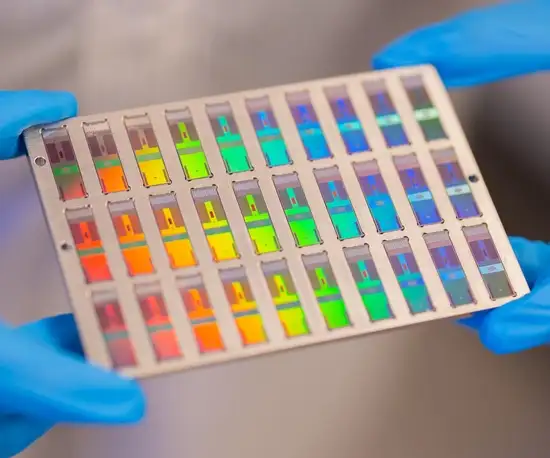
We offer manufacturing services that are suitable for a variety of microarray platforms ideal for applications in diagnostics and life sciences. With the ability to dispense on a broad range of substrates – including glass, various polymers, and silicon chips and wafers – we provide our customers with the flexibility to develop products using commercially available substrates or fully custom formats and designs.
Glass

Glass microarrays

Our glass microarrays are developed using a range of glass substrates, such as NEXTERION® specialty glass, in slide, plate, or custom size dimensions with functional surface coatings that drive effective biomolecule attachment. NEXTERION® offers multiple products in this realm and can help guide the optimal selection. In addition, unique customer formats and alternate functional coatings are all feasible within our custom offerings.
Glass microarrays
On-the-fly printing on glass substrates

Materials

Depending on the assay and type of array (DNA or protein) a different functional coating may be required to complement the molecule adherence.


Your advantages

There are many advantages to printing on glass including:

  • High-quality optical glass allows for scanning through the glass with minimal impedence, and therefore increased optical transmission. With high-quality, flat glass and fewer defects experienced compared with other materials, the transparency allows scanning from all sides for optimal signal quantification.
  • Glass has lower auto-florescence in comparison to other materials such as  nitrocellulose and many polymers, eliminating interference with signal quantification.
  • Glass is more cost-effective as an alternate to silicon for cingulated point-of-care device production.
Polymer / plastic

Polymer / plastic microarrays

Our polymer / plastic microarrays are developed using a variety of polymer-based substrates of unique and custom dimensions. We apply functional surface coatings compatible with polymer to allow for chemical binding of biomolecules to the polymer substrate. Custom fixturing for these unique dimensions can be produced for both on-the-fly and stop-and-drop dispensing.
Polymer / plastic microarrays
SCHOTT® Microarray 96-well plate

Materials

Common materials used for printing polymer microarrays include: COP, COC, polypropylene, acrylic.


Your advantages

The main advantage of polymer-based microarrays is cost-effectiveness, particularly in the production of high-volumes of polymer substrates through injection molding to reduce overall product COGs.

Silicon

Silicon microarrays

Custom silicon microarrays can be developed using silicon die, packaged chips, or silicon wafer substrates in a variety of custom dimensions. These silicon formats can be functionalized with many of the same surface coatings used in glass microarrays, allowing for broad utilization across biomolecule type with effective chemical binding. 
Silicon microarrays
Microarray printing on silicon packaged chips

Materials

We print on silicon die, packaged chips and wafers to enable optimal detection in both labeled and unlabeled molecular assay platforms.


Your advantages

The use of silicon as a substrate allows for many types of detection beyond standard fluorescence, such as electrical detection, differential mass determination, and ion quantification. The unique properties of silicon enable:

  • Complex and accurate sensor pad definition and the ability to make unique sensor pad format layouts.
  • Electrical detection for signal read outs and electrically driven on-chip control of temperature including on-chip PCR cycling.
  • Intricate on-chip microfluidics to drive assay flow.
Webinar

Unleashing the full power of microarrays

Watch our recent GenomeWeb webinar to hear from the experts about the latest innovations in microarrays powering diagnostic discoveries around the world.

FAQs

The optimal substrate depends on the application, sample chemistry, biomolecule type, surface chemistry, detection method, product format, and manufacturing requirements. SCHOTT MINIFAB can work with customers to evaluate substrate options such as glass, silicon, polymer/plastic, nitrocellulose, films, and other application-specific materials. Our team can provide proposals based on assay needs, detection approach, array density, surface functionalization, and scale-up targets. Selecting the right substrate early in the process can help improve assay performance and manufacturability. 
SCHOTT MINIFAB can produce microarrays on a range of substrate materials in standard or custom shapes and sizes. Supported materials include glass, polymer/plastic, silicon, nitrocellulose, films, and other application-specific materials. The choice of substrate is driven by the assay format, biomolecule attachment, optical or non-optical detection method, surface chemistry, and production requirements. Our team can help evaluate which material best fits the technical and commercial goals of the product.
SCHOTT MINIFAB can support standard microscope slide formats as well as plate-based and custom substrate formats. Arrays can be developed on glass, polymer/plastic, silicon, nitrocellulose, films, or other application-specific materials depending on the product requirements. Custom formats may require dedicated fixturing, print-path development, or dispensing optimization to support accurate placement and manufacturability. Our team can review the intended format and help determine a practical approach for development and scale-up.
The level of automation depends on the application, product format, throughput requirements, process complexity, and stage of development. SCHOTT MINIFAB can support automation at different stages of the product lifecycle, and in process steps ranging from sample formulation through post-processing and preparation for packaging. Semi-automated and fully automated options, including customized robotic platforms, may be implemented depending on the product. The appropriate automation strategy is defined according to the product design, quality requirements, and manufacturing scale.

Would you like to learn more about SCHOTT® Microarray materials? Let’s talk!

Accelerate your vision and get to market faster!

Dieter Cronauer

Dieter Cronauer