Product Variants of NEXTERION® glass substrates
To cater to the demand for customized products, we specialize in the development of distinctive formats, materials, coatings, structuring and bonding solutions. Leveraging our stringent quality standards and efficient volume production methods, we empower our customers to achieve consistently reproducible results, addressing the evolving challenges of diagnostic and life science endeavors. Explore the below for an overview of available bonding methods and design options.
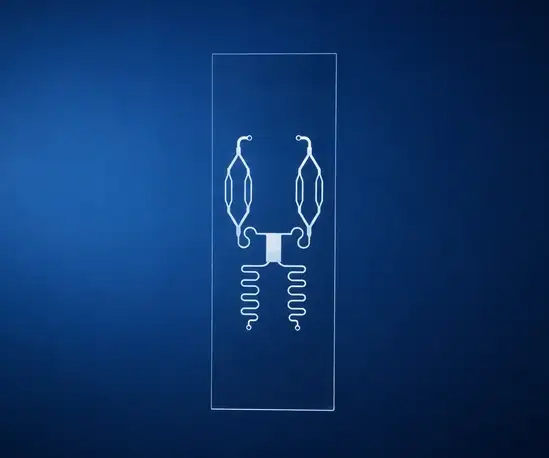
NEXTERION® bonded glass substrates


CHARACTERISTICS
-
Tape bonding
For all NEXTERION® taped-bonded products the channels are formed via adhesive tape. The channel depth is defined by tape thickness. This allows an optional functional coating on either top or bottom plate. -
Fusion bonding
All NEXTERION® fusion-bonded products are fully glass-based systems in multiple layer designs with layers aligned via direct bonding. -
Coating bonded products
Bonded products can be coated as well, depending on type of coating and coating technology.
YOUR ADVANTAGES
Manufacturing takes place in ISO class 7 environment, all relevant processes are in place for diagnostic company needs.
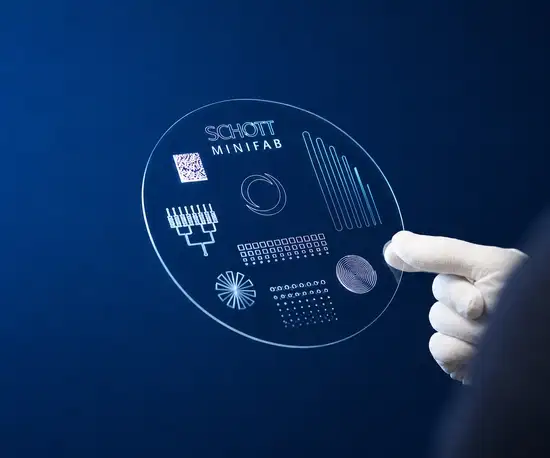
NEXTERION® structured glass substrates



CHARACTERISTICS
1. Material
The standard glass types used for NEXTERION® glass substrates are our borosilicate glass types BOROFLOAT® or D 263®. If needed, we can also offer other options selected from the wide range of SCHOTT specialty glass materials.
2. 3-D structures
To enable customization we use multi-layer designs to create 3-D structures in glass. Structures will either be created by laser-ablation or by stacking of structured layers. This technology can also be combined with adhesive tape layers. The thickness of the layers ranges from 0.07 mm to 2 mm.
3. PreScora
The growing complexity of the consumable biochip market is driving demanding applications. Very often further processing on wafer level is required. For diagnostic products final separation into chips, using conventional dicing processes bare a high risk of contamination. To solve this problem, we are offering pre-scored substrates that are scribed into the final chip size to be separated into the requested format at the needed step of the process chain without dicing.
YOUR ADVANTAGES
By using the same qualified technologies, processes, and quality systems that govern full-scale production, we reduce your setup time, optimize cost-efficiencies, and simplify scale-up. From first prototypes through process validation, early clinical trials, and into commercial launch, our flexible, advanced technology infrastructure adapts to your needs – providing flexibility in early stages and seamless transition to production, from glass prototypes to your complete consumables.
- Complete solutions for biochips
- Fast high-quality prototyping
- No masking required for 3-D structuring
- Flexible and high precision structuring
- High-performance diagnostic-quality glass substrates
- Available with additional organic and/or inorganic coatings
- Available with markings or barcodes
- Competitive pricing for glass biochips
- ISO class 5 clean room production
- ISO 9001 and 13485 certified
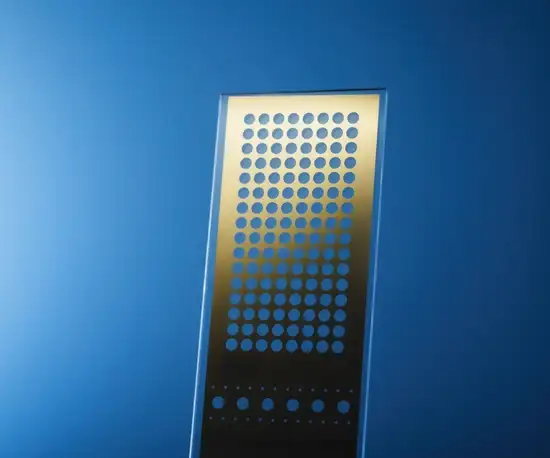
NEXTERION® coated glass substrates



CHARACTERISTICS
1. R&D stage coatings
Work with our team of experts to develop customized organic coatings for your application.
2. Organic coatings
Featuring a various assortment of coating technologies, e.g. dip coating, chemical vapor deposition (CVD), solvent-based reactor method, spin coating we are offering a portfolio of standard coatings as well as customized coatings. Customization may either be the development of specific coatings for a special application or the process transfer of an already established coating. Our production facilities are equipped to meet your manufacturing needs from early prototyping to serial production.
Standard organic coatings:
-
Aldehydesilane coating
-
Aminosilane coating
-
Epoxysilane coating
-
Poly-L-Lysine coating
-
Streptavidin coating
-
Thin-film hydrogel coating
-
3-D Polymer coating
-
3-D Epoxy coating
-
Thin-film Nitrocellulose coating
-
Hydrophobic coating
-
Polyethylene glycol coating
-
Methacrylate coating
3. Inorganic coatings
Offering a diverse selection of available coating materials, applied by physical vapor deposition (PVD), atomic layer deposition (ALD), radio frequency (RF) sputtering, and reactive sputtering, we are equipped to develop and optimize your specific coating process and scale manufacturing. To provide maximal customization, we are able to structure the coating by masking or in post processing.
Examples of inorganic coatings:
-
Metallic coatings, e.g. Copper, Aluminum, Silver, Gold, Chrome, Nickel, Titanium
-
Oxidic coatings, e.g. Silicon Oxide, Alumina, Chromium Oxide, etc.
-
Cermet coatings, e.g. Black Chrome, Aluminum/Alumina
-
Transparent conductive materials, e.g. ITO
-
Customized coating
YOUR ADVANTAGES
- Wide range of organic and inorganic coatings
- Structuring of coatings
- Option of double-sided sputtering
- Combination of different coating options
- Reliable and homogeneous coating
- Flexibility in glass material and dimensions
- Available with markings or barcodes
- High batch quantity
- ISO class 5 clean room production
- ISO 9001 and 13485 certified
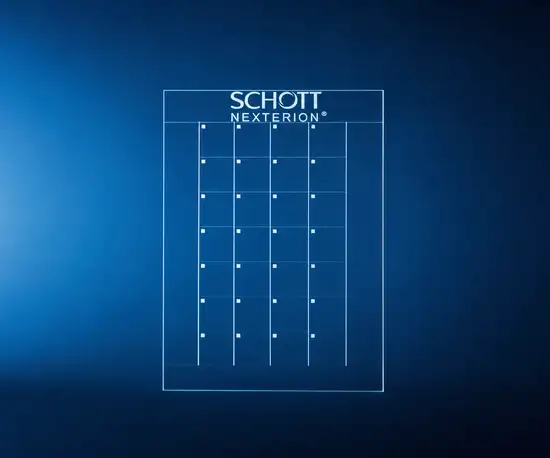
NEXTERION® uncoated glass substrates



YOUR ADVANTAGES
BOROFLOAT® 33 and D 263® are produced with the purest raw materials and manufactured with stringent quality controls systems. The manufacturing process results in a pristine, fire-polished surface, making it the perfect material for diagnostics and life science research. The uncoated glass material types are cleaned in an ISO class 5 cleanroom and offered in standard and custom formats, to meet tolerances and technical specifications.
Want to know more? Let's talk
Whether you need more information, samples, a quote, or advice for a project, I would be delighted to talk to you.

Spencer Perry