Imaging
Why imaging performance is decided before the first pixel
Imaging systems demand ever-greater sensitivity and precision, capturing optical information under tight optical, mechanical, and environmental constraints.As optical module shrink and integrate more tightly, imaging performance is no longer dictated by electronics or algorithms alone. Instead, it is shaped by the material properties that define optical behavior before the first pixel is ever captured.
Once optical information is degraded at this fundamental stage, no amount of downstream processing can fully restore it.
Imaging performance is not created in software - it is enabled by material stability designed into the system from the very beginning.

Why imaging performance is defined across optical components
Unlike mobile sensing, imaging performance is not just about scaling. It is fundamentally constrained by the irreversible loss of signal integrity once optical limits are exceeded.
Imaging performance no longer depends on isolated components. It is determined by how precisely individual optical elements interact within the optical module.
Small deviations at the component level ripple through the optical path, directly degrading image quality and signal-to-noise ratio.
What really defines imaging performance today
Before pixels, software, or AI enter the picture, imaging systems rely on more fundamental factors.
Signal quality comes before resolution
Optical signal integrity is defined before detection even begins. Refractive index uniformity, high transmission in visible and near-infrared ranges, and stable optical paths determine how much light actually reaches the sensor. If light quality is compromised at this stage, system limitations are permanently locked in.
Three failure modes that software cannot fix:
- Non-uniform refractive index: Alters optical path length and blurs images irreversibly.
- Wafer-wide TTV and warpage: Create field-dependent focus mismatches across the sensor.
- Low optical transmission: Permanently reduces signal-to-noise ratio and dynamic range.
Glass is not a neutral window in this context. It actively defines how light enters, propagates, and exits the optical stack. Decisions at the material level determine the achievable signal quality long before image processing begins.
Core imaging and sensing modalities
Imaging and sensing systems differ in architecture but share the same underlying physics. Different modalities translate light into information in distinct ways, yet all operate under identical physical constraints.


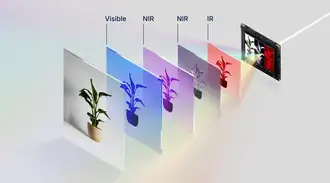
Why lab performance rarely survives the field
Imaging and sensing systems are rarely deployed under ideal conditions. Real-world operation introduces temperature cycles, vibration, humidity, chemical exposure, and aging effects that accumulate over time.
Materials that deform, drift or change their behavior under these conditions gradually destabilize the system. Focus shifts, alignment drifts, and signal quality degrade – often long after initial calibration.
In imaging applications, the central question is not regulatory lifetime compliance. It is whether optical signal quality survives long-term integration.
The relevant question is not whether an imaging system works on day one, but whether it continues to perform reliably after years in real-world operation.
Miniaturization without performance loss
The push toward smaller, thinner, and lighter systems has fundamentally transformed imaging design.
Miniaturization amplifies sensitivity to material behavior. Thinner substrates and higher integration density make thickness variation, flatness, and optical homogeneity even more critical.
In active modalities like structured light and time-of-flight sensing, even minor material deviations directly translate into measurable depth errors.
Glass as an active system component
In modern imaging and sensing systems, glass is no longer a passive window. It becomes a functional part of the optical module, actively shaping optical performance.
Unique properties enable high-sensitivity imaging and sensing systems by preserving signal integrity and stable optical behavior.
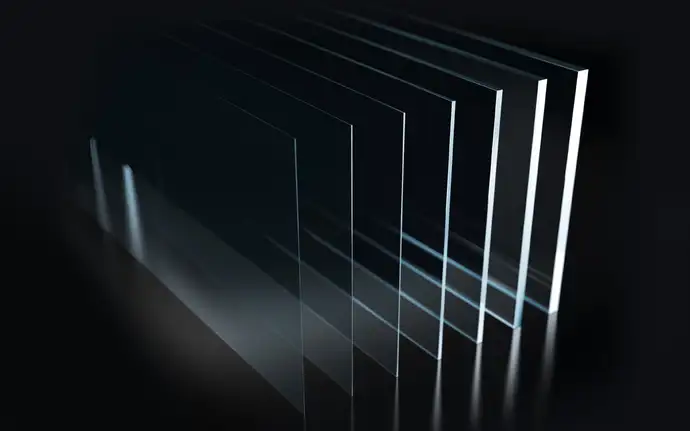
Key material properties for high-performance imaging


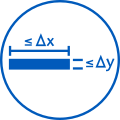


SCHOTT offers a broad portfolio of specialty glass engineered for demanding optical applications. These materials are designed to meet defined optical, geometrical, and stability requirements within imaging components such as filters, cover glasses, and optical substrates.
Backed by more than 140 years of glass expertise, these materials form the foundation for high-quality imaging performance across industries.
Representative materials
AF 32®
Thin, super-flat glass for highly integrated optical stacks and CTE-matched wafer-level packaging.
D 263® T
The gold standard widely used for optical components, filters, and geometrically demanding substrates.
BOROFLOAT® 33
Robust borosilicate glass for imaging systems requiring high transmission from UV to VIS and NIR.
Easy to process and bond, enabling flexible integration into advanced imaging assemblies.
From material properties to scalable optical components
Modern imaging components increasingly rely on fabrication technologies where optical precision is defined at the wafer and surface level.
Wafer-level optics, nanoimprint lithography, and metalenses translate material properties into reproducible optical components at scale.
They do not define system architecture —they determine whether optical performance can be realized consistently in high-volume production.

Wafer-level optics
Enables high-precise fabrication of micro-optics at wafer scale, where systematic deviations are replicated without opportunity for downstream correction. Planarity, TTV and CTE-driven optical behavior become system-defining parameters.
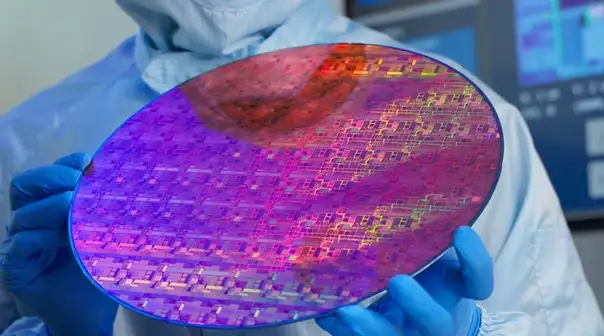
Nanoimprint lithography
Replication replaces assembly. Optical function is etched directly onto the surface. Material uniformity, highly precise geometrical properties, and mechanical stability determine whether nanoscale structures translate into real-world performance.
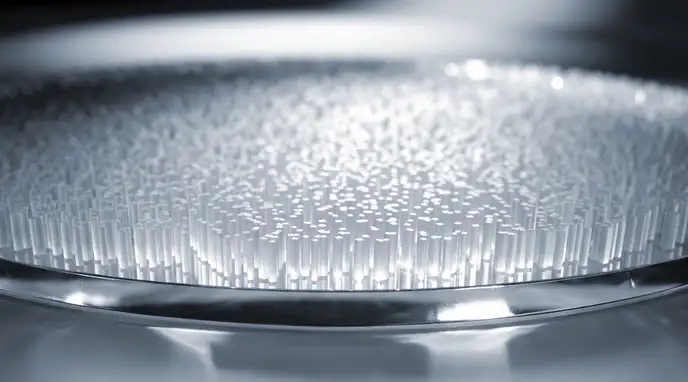
Metalenses
Compress optical systems into planar, structured surfaces. Optical behavior is encoded into nanoscale geometry. Geometrical properties and surface quality directly define focus, phase, and polarization accuracy.
Co-engineering as a design principle
Imaging performance is not optimized in isolation. It emerges from the interaction between material properties, optical design, and integration constraints.We support customers from early material selection to scalable production by providing:
- Material definition aligned with optical and mechanical performance requirements
- Design-for-manufacturing considerations at wafer and component levels
- Qualification support under defined operating conditions
- Reliable supply for high-volume applications
The result is predictable, reproducible imaging behavior.
Where material behavior defines imaging performance
The material and integration principles described here apply across diverse imaging and sensing applications. Across all applications, imaging performance is ultimately defined by physical and optical material behavior.

Automotive imaging and sensing

Mobile sensing

Industrial inspection

Medical imaging and sensing
Imaging performance starts before the first pixel
Material behavior defines signal quality long before image processing begins. Describe your system requirements, and we will help you match them with glass properties that enable consistent optical performance.