Mobile sensing
Performance is defined by variation at scale
Mobile sensing brings high-sensitivity optical perception into billions of everyday devices. From biometric authentication and 3D perception to augmented reality, consistency and reproducibility are non-negotiable across global manufacturing volumes.
As optical stacks shrink and integrate further, performance is defined not just by component precision, but by reproducible material behavior across millions of devices.
Stable refractive indices, high transmission in visible and near-infrared ranges, and controlled thermal expansion ensure consistent sensing performance long before calibration or software optimization even comes into play.
Unlike regulated or safety-critical environments, mobile sensing leaves no room for calibration, redundancy, or manual adjustment. Performance must be reliable by design. Invisible when it works, but immediately obvious when it fails.
The unforgiving realities of mobile sensing
Mobile sensing operates under a unique and relentless combination of constraints:
- Extreme miniaturization with minimal optical path lengths
- High-volume manufacturing with near-zero performance variance
- Stable signal behavior without post-production calibration or compensation
- Longevity under lifetime, temperature, and usage cycles
At this scale, robustness is not achieved through correction or post-processing – it is achieved when material behavior is predictable enough that correction becomes unnecessary.
Mobile sensing systems must function as scalable, reproducible optical components, not as individually optimized devices.
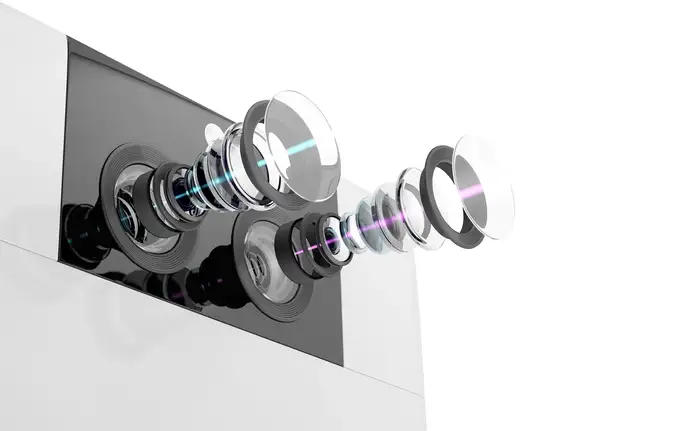
Why miniaturization amplifies material effects
As mobile sensing systems shrink, physical tolerances tighten dramatically:
- Thinner substrates increase sensitivity to mechanical stress
- Shorter optical paths magnify alignment deviations
- Higher integration density leaves no room for compensation
At this point, sensing performance is no longer defined by nominal design intent alone. It is defined by how materials behave in real devices, at production scale.
Why mobile sensing fails at scale
Mobile sensing systems rarely fail due to missing features or weak algorithms. They fail when material-induced variance turns identical designs into inconsistent devices. At production scale, even minor thickness, alignment, or spectral variation directly impacts user experience and trust in the device.
Mobile sensing without a correction loop
At mobile scale, continuous calibration or downstream correction is not an option. Once devices leave the production line, material-induced variance defines sensing behavior immediately – across millions of units, with out delay or compensation.
Functional sensing architectures in mobile devices
Mobile sensing systems are built around tightly integrated optical architectures. Each function combines emitters, optics, sensors, and materials into compact modules where optical stability, timing accuracy, and reproducibility directly define performance.
Structured light sensing

In mobile devices, performance is highly sensitive to optical homogeneity, spectral control, and mechanical stability. At scale, material-induced variation translates directly into:
- Depth reconstruction errors
- Inconsistent recognition behaviour
- Inconsistent authentication behavior
What users perceive as a software issue is often a material variance issue at the module level. Typical system elements:
- Dot projector
- Flood illuminator
- IR camera
Time-of-Flight (ToF) sensing

At scale, the causal chain is undeniable: even minor thickness or TTV variations lead to timing deviations, which in turn cause depth errors – and ultimately, loss of user trust.
As a result, depth precision and measurement stability depend as much on material stability across production batches as on electronics or algorithms.
Typical system elements:
- Emitter
- Receiver
- Narrow band filter
- Diffusers
- Diffractive optical elements
Stereo vision and camera-based perception

Thickness variation, thermal expansion, and mechanical drift directly affect:
- Depth accuracy
- Image consistency between devices
- Long-term stability over the device lifetime
Typical system elements:
- Camera modules
- Lens cover glass
- Filters
- Spacers and alignment elements
Glass: The silent enabler of mobile sensing performance
In mobile sensing, material properties do not optimize performance – they determine whether performance is reproducible at scale. Glass enables performance by reducing variance, not by adding features. The SCHOTT portfolio of specialty thin glasses is engineered for the demands of mobile sensing applications. These materials deliver stable optical behavior, tight tolerances, and reproducible performance across high-volume manufacturing. Their key properties include:



Key optical components enabled by glass:
- Image sensor covers
- Wafer-level optics (WLO)
- Microlens arrays
- Narrow-band filter substrates
- Diffractive optical elements
Selected materials
D 263® T
With tight thickness tolerances, low total thickness variation (TTV), and excellent surface quality, D 263® T enables high-fidelity replication and precise optical stacking in compact sensing modules.
Its uniform optical behavior ensures consistent performance across millions of devices, where even minimal variation directly impacts sensing accuracy.

AF 32®
AF 32® combines low thermal expansion with high optical homogeneity, ensuring stable alignment and consistent performance in highly miniaturized sensing systems.
It preserves nanostructure integrity under thermal and mechanical stress, where no post-production correction or calibration is possible.

Enablement at scale: WLO, nanoimprint and metalenses
Advanced mobile sensing systems rely on integration technologies that preserve optical precision while enabling volume scalability.

Wafer-level optics
Optical functions are integrated at wafer scale, enabling compact and reproducible modules. Material precision ensures alignment-free performance across millions of devices.

Metalenses
Optical behavior is encoded into nanoscale structures. Material stability and refractive control define focus, phase and performance without adjustment.

Nanoimprint lithography
Replication replaces alignment. Material fidelity replaces adjustment. Optical performance is defined by how precisely nanostructures are reproduced at scale.
Related sensing contexts
The principles behind mobile sensing apply across multiple domains where high-sensitivity perception matters under different constraints:

Automotive sensing

Imaging and sensing systems

Pressure sensors
Define stable sensing performance at scale
Mobile sensing systems rely on precise and reproducible material behavior. Tell us about your application, and we will support you in selecting glass materials for consistent performance across high-volume production.