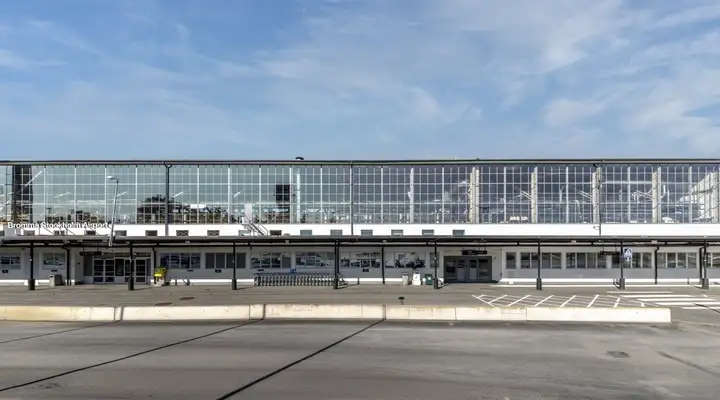
Historic glazing for modern requirements at Bromma Stockholm Airport
Key figures
Background
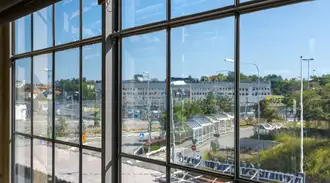
Located in the Bromma district, a few miles west of Stockholm in Sweden, Stockholm Bromma Airport is a typical example of 1930s functionalist architecture. The façade of the airport building is characterized by clear horizontal lines and a flat, elongated design, and comprises reinforced concrete with narrow steel frames that support large ribbon windows extending across the entire length of the terminal. These large windows let plenty of daylight into the passenger areas to create an open, transparent connection between the interior and exterior of the building.
Task
A key challenge in restoring the façade of Bromma Stockholm Airport was to preserve the building’s listed historic status while meeting modern technical requirements. The intricate steel and glass structure of the façade is characteristic of 1930s functionalist architecture.
While many components of the façade had become worn from old age, from a heritage conservation perspective, they could not simply be replaced. Instead, they needed to be preserved, repaired or replicated wherever possible.
Another challenge was integrating modern glazing into the historic structure. The new glass elements needed to provide significantly better thermal insulation and soundproofing properties, but without altering the visual appearance of the original façade. This required specially developed glass and customized solutions, as the existing steel profiles only permitted limited tolerances and were not designed for standard formats.
Solution
The solution to this challenging restoration project was to upgrade the glazing using modern heat- and vacuum-insulated glass within the existing frames. This was made possible by the unique properties of FINEO vacuum glazing, which offered installation without structural modifications. The choice of FINEO “Heritage Classic” glazing made it possible to significantly increase the energy efficiency of the façade while maintaining its visual quality.
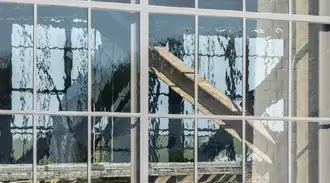
To resemble the original glass from the 1950s, the vacuum glass was laminated with 4 mm-thick SCHOTT RESTOVER® glass for restoration to a total thickness of 13.5 mm, providing the same irregular, slightly wavy surface as glass from that period. Vacuum glass is between 6-10 mm in thickness, depending on the required specifications, and has U-values ranging from 0.6-0.8 W/m2K. To achieve the same U-value with insulating glass, the glass would have to be 35-40 mm thick.
This solution also made it possible to retain the existing steel structure, which reduced costs and material consumption, while minimizing construction time and disruptions to airport operations. The major renovation work began with removing rust from the existing steel facade and applying a special paint to stop corrosion. Ryds Glas also removed several thousand rusty screws, replacing them with new stainless steel ones. The glass panes were then replaced.
The restoration of the glass façade combined heritage conservation objectives, modern building requirements and practical solutions. This allowed the façade to be renewed while preserving its historic character and adapting its functionality to modern requirements. The Bromma Stockholm Airport project demonstrates how cutting-edge vacuum glazing and heritage glass can deliver the energy-efficient renovation of listed buildings with precise architectural constraints.

Used materials
FINEO 10 mm “Heritage Classic” with SCHOTT RESTOVER®