Structure and Optics: Otto Schott Research Award 2026 honors two U.S. glass scientists
Monday, 13 April 2026, Germany, Mainz
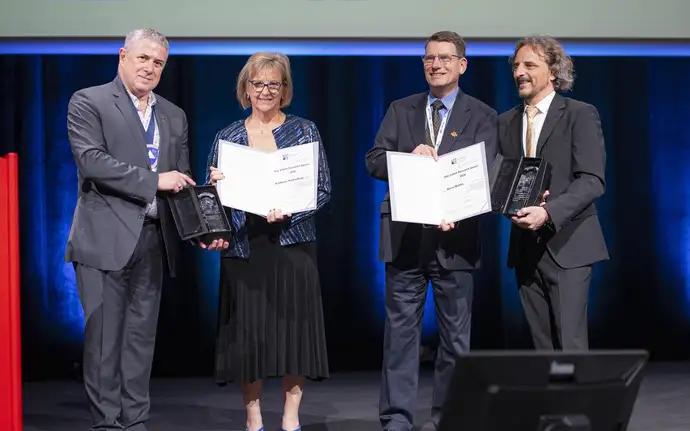
- Professor Steve Martin of Iowa State University and Professor Kathleen Richardson of the University of Central Florida have received the Otto Schott Research Award 2026 for their outstanding research.
- Their work on new material properties expands the range of glass applications in future technologies.
- With this award, SCHOTT emphasizes the close connection between scientific excellence and industrial application.
How atomic structure defines glass properties
Steve Martin, professor of materials science and engineering at Iowa State University, is recognized for his fundamental research on the structure of silicate and non-oxide glasses. His work demonstrates how atomic structure determines key properties of glass, such as resistance to high temperatures, chemical exposure, and long-term stress. This understanding is essential for developing specialty glass tailored to demanding applications, including pharmaceutical packaging and energy-intensive industrial processes. His research also opens new possibilities in energy technologies, particularly solid-state batteries.“Dr. Martin’s pioneering work in glass science has forged new frontiers in battery technology. His discoveries and innovations make us more energy-secure while contributing to the overall strength or our nation’s economy,” says Dr. Peter Dorhout, Vice President for Research for Iowa State University. “We’re proud of Dr. Martin’s accomplishments and his contributions that have made Iowa State a recognized leader in materials science and engineering.”
Controlling light with optical glass
Kathleen Richardson, professor of optics and materials science and engineering at the University of Central Florida’s CREOL, is honored for her contributions to the development of optical glasses and infrared materials. Her research focuses on how precisely engineered compositions can control and transmit light. This is particularly important for high-performance applications in infrared optics and sensing systems.“Dr. Richardson has a sustained career that has driven significant advancement in infrared material technologies, laying the foundation for next‑generation sensing and defense capabilities,” says Winston Schoenfeld, vice president for research and innovation at UCF. “Her relentless pursuit of discovery in optical and infrared materials illuminates UCF’s expanding impact on the frontiers of advanced technologies that continue to shape the future.”
The work of both awardees demonstrates the close link between fundamental research and industrial application. It helps push the performance limits of existing materials and unlock entirely new material classes – such as glasses with lower melting temperatures or extended optical properties in the infrared range.
“The research of Steve Martin and Kathleen Richardson clearly shows how essential a deep understanding of material structures is for technological progress,” states Dr. Matthias Müller, Head of Research and Development at SCHOTT. “These insights form the basis for developing new glass solutions that perform reliably in real-world applications and expand the boundaries of what is possible.”
The award, endowed with €25,000, was presented on April 13, 2026, during the annual meeting of the International Commission on Glass in Lyon, France. The presentation of the award by the Ernst Abbe Fund underscores the importance of linking scientific excellence with industrial implementation. The goal is to translate research insights into scalable technologies and enable practical applications with societal impact. The Otto Schott Research Award is presented every two years and is among the most prestigious honors in glass and materials science.
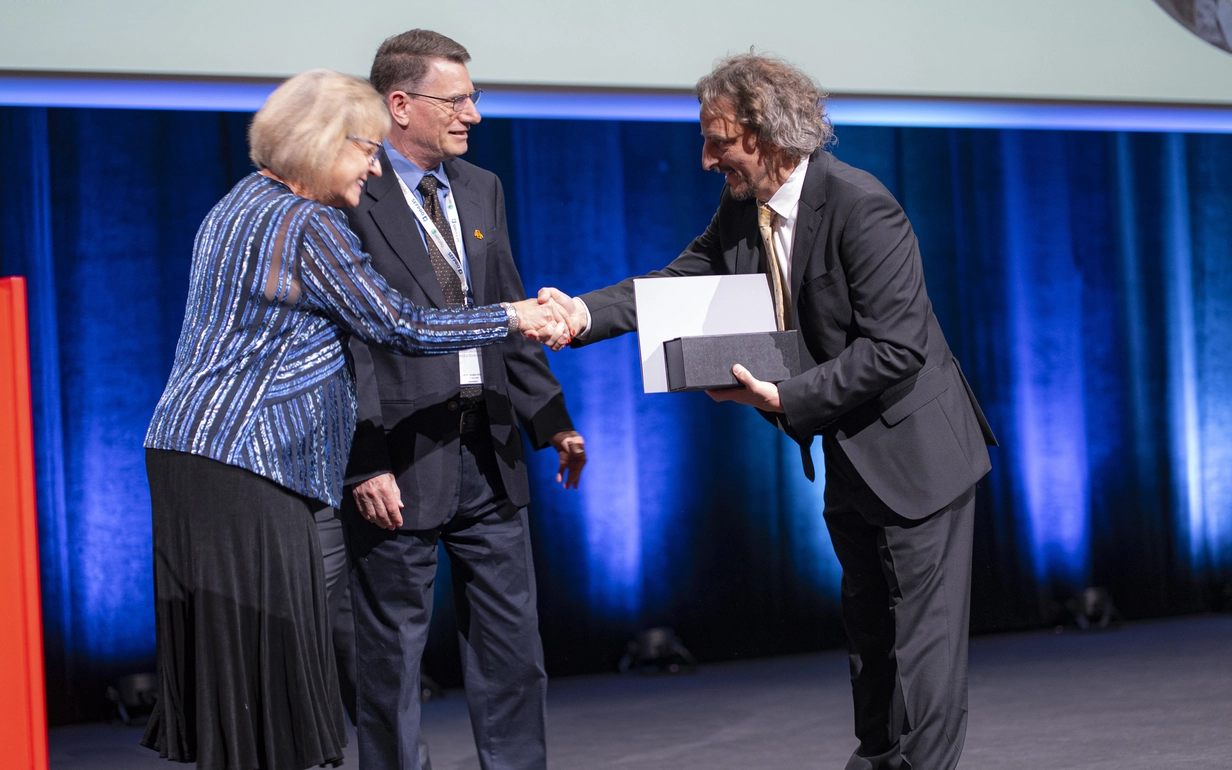
The award, presented by the Ernst Abbe Fund, was handed over by Dr. Matthias Müller (right) and Daniel Neuville. Picture: SCHOTT
About SCHOTT
International technology group SCHOTT produces high-quality components and advanced materials, including specialty glass, glass-ceramics, and polymers. Many SCHOTT products have high-tech applications that push technological boundaries, such as waveguides for augmented reality smart glasses, glass-ceramic mirror substrates in the world's largest telescopes, and laser glass in nuclear fusion research. With a pioneering spirit, SCHOTT’s 17,400 employees in over 30 countries work as partners across industries such as healthcare, home appliances, consumer electronics, semiconductors, optics, astronomy, energy, and aerospace. In fiscal year 2025, SCHOTT generated sales of EUR 2.83bn and an EBIT of EUR 230m. Founded in 1884 and headquartered in Mainz, Germany, SCHOTT is owned by the Carl Zeiss Foundation. As a foundation-owned company, SCHOTT pursues long-term innovation and conducts its business with a strong sense of social responsibility, reinvesting its success into the advancement of science and society. Learn more at SCHOTT.com
