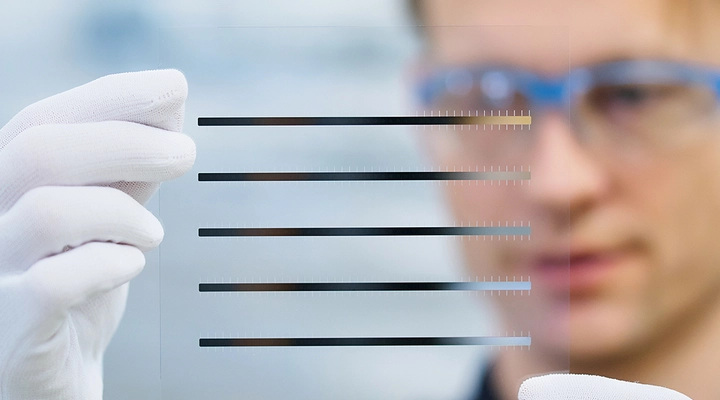
NEXTERION® specialty glass products for pharmaceutical and drug development
The science behind the surface
The performance of any pharmaceutical assay begins long before the first molecule is introduced. It starts with the glass, and with the coatings, markings, and structures applied to it.
Coatings are essential to bind and stabilise biomolecules on a glass surface in a specific and reproducible way. Depending on the detection method and application, the type of coating directly determines signal-to-noise ratio, autofluorescence levels, and unspecific binding behaviour. A coating that generates high background noise lowers signal-to-noise ratio; higher autofluorescence can result in unspecific binding – both outcomes that compromise assay validity.
For microfluidic products, coatings also control wettability and antifouling performance, influencing how fluids move through channels and preventing biological materials from adhering to channel walls.
Precision markings, including barcodes for traceability and fiducial markers such as crosshairs and circles, enable automated optical systems to orient and locate features on the substrate with accuracy that manual alignment cannot match. For product developers running automated workflows, this is not a convenience – it is a requirement.

Quality you can measure, results you can trust
Glass quality is not a background consideration – it is the foundation of every result your assay produces. If glass properties are not uniform, you will experience signal interference and inconsistent results.
Thickness tolerance is a prime example. In flow cell applications requiring single-molecule optical detection, even minor variation in cover glass thickness can degrade image quality and compromise data integrity. The optics involved in single-molecule detection are extraordinarily sensitive. Variation that might seem negligible in other contexts directly impacts the quality of the image captured.
Our in-house glass production enables total control of the glass process and supply-chain, from raw materials to final product. NEXTERION® specialty glass products are produced at cleanroom quality, guaranteeing defined levels of cleanliness and surface activation. Our sophisticated cleaning processes and controlled storage conditions preserve substrate performance from production to point-of -use, because how a substrate is processed and handled before it reaches your lab is as important as how it is made.

More signal, less noise, fewer compromises
The type and density of functional reactive groups on a glass surface determine how effectively biomolecules can be immobilised and how clearly their interactions can be detected. Non-specific binding must be minimised to achieve a desirable signal-to-noise ratio, while loading capacity directly influences signal intensity.
3D polymer coatings address both challenges simultaneously. Functionalized with a long-chain polymer covalently linked to the glass surface, 3D coatings provide a significantly higher density of reactive groups and incorporate structural features that inherently reduce non-specific binding. The result is a higher signal-to-noise ratio from the same amount of probe material, meaning more tests can be run with less material, lowering costs, and generating results that can be trusted at lower detection thresholds.
This matters most when probe material is scarce or detection thresholds are extremely low. Consider early cancer diagnosis: when testing for new treatments, biomarker concentrations in patient samples can be vanishingly small. In these applications, signal quality and a high signal-to-noise ratio are not performance targets – they are the difference between a reliable result and no result at all.
The same principle applies across drug development workflows where data quality requirements, including the consistency standards expected for FDA approval, demand that every data point can be trusted.
Consistent results, need standardized glass products
Your results are directly influenced by the variation in the substrates you use. The lower the variation in the substrate, the lower the variation in test quality.
The product with the lowest intrinsic variation and batch-to-batch variation will provide you with the reliability you need, and that your customers and regulators expect. NEXTERION® glass products leverage an established, advanced technology infrastructure and a fully automated coating process to deliver the lowest variations, enabling consistent results across pharmaceutical and discovery applications.

One platform, multiple answers, powered by NEXTERION®
NEXTERION® glass substrates support multiplexed assay formats, enabling teams to analyze multiple samples in parallel on a single substrate. By combining standard and customized coatings with tailored designs, we deliver optimized solutions for your specific application.
The most suitable coating is biomolecule specific. Depending on the application and the reactive groups present on the biomolecule surface, we determine the most appropriate coating type and apply and stack multiple coatings via different technologies on the same substrate.
When developing new drugs, teams must test interactions between hundreds to millions of potential new substances and their cellular targets. We offer customized coating solutions in the highest quality to support high-performing, high-throughput drug discovery workflows. We can apply multiple functional (organic and inorganic) coatings on a single substrate, enabling the combination of complementary surface properties within one integrated system.
Related capabilities
We offer a complete ecosystem of capabilities to take your product from concept to clinic.

Explore glass products
Custom flow cell design and manufacture for pharmaceutical assay and drug discovery applications.

Organic and inorganic coatings
Our full range of organic, inorganic, 2D and 3D functional coatings for life science applications.

SCHOTT® Microarrays
End-to-end solutions from glass substrate to fully assembled, market ready consumable.
Want to know more? Letʼs talk.
Whether you need more information, samples, a quote, or expert advice for your project, our technical team would be delighted to talk to you.

Spencer Perry