Fiber optic laser solutions for medical applications
What is medical laser light treatment?
Laser light treatment uses precisely controlled light energy to diagnose, illuminate or treat tissue within or on the body. Depending on the medical application, laser light can:
- activate photosensitive agents
- generate localized heating
- destroy targeted tissue
- stimulate biological responses
- improve visualization.
Why is light delivery critical?
The effectiveness of laser-based medical treatments depends on delivering the required light dose, wavelength, and emission profile to the target area. Losses occur at coupling interfaces and along the optical transmission path due to absorption and scattering, which can reduce system performance. At the same time, non-uniform light distribution may lead to hot spots or inconsistent outcomes. Optimizing the complete optical path, from source coupling to final emission, enables predictable light delivery across many applications.
Applications of medical laser light delivery systems
Medical laser light delivery is a key enabling technology for minimally invasive procedures and surface therapies. Each application has its own optical delivery challenge and requires a well-designed optical path consisting of a specific combination of laser source, optical fiber assembly and emission profile.
Cavity-based, intraluminal and endoscopic light delivery
Some medical laser applications require light to be delivered into hollow organs, luminal structures, endoscopic access sites or post-resection cavities, typically to diagnose or treat cancer. Examples include applications in the bladder, gastrointestinal tract, bronchial tree, pleural space or surgical cavities. Depending on the therapy concept, light may be used for photodynamic therapy (PDT), photoimmunotherapy (PIT), photodynamic diagnosis (PDD), illumination or localized treatment.These procedures require controlled and homogeneous light distribution within confined and often complex geometries. Cylindrical, spherical or application-specific diffuser geometries and fiber optic probes can support defined emission profiles and reproducible irradiance at the treatment site.

Interstitial and intratumoral light delivery
Interstitial and intratumoral therapies deliver optical energy directly into tissue through minimally invasive fiber-based probes or applicators. This approach is used when the target such as a tumor or epileptic node lies within tissue rather than on an accessible surface or inside an open lumen. Examples include laser interstitial thermal therapy (LITT), interstitial photodynamic therapy (I-PDT), focal tumor ablation and other localized oncology procedures.These applications require controlled energy deposition within a defined tissue volume. Depending on the therapy mechanism, the goal may be thermal tissue ablation, activation of a photosensitizer or controlled illumination of a target volume.

Endovenous light delivery
These therapies deliver laser energy within blood vessels to treat vascular diseases while minimizing trauma to surrounding tissue. Endovenous laser treatment (EVLT) is widely used to treat varicose veins, chronic venous insufficiency and other forms of venous reflux disease.These procedures require controlled and uniform energy delivery along the vessel wall to achieve reliable thermal interaction and vessel closure. Laser diffusers and laser fiber probes create homogeneous radial emission profiles that support consistent irradiation of the treatment zone. Optimized fiber delivery and emission geometry are therefore key design factors for reproducible outcomes in vascular laser applications.

Directed endoscopic laser light delivery
Directed endoscopic laser applications require precise delivery of optical energy to a defined target rather than broad homogeneous illumination. Examples include laser lithotripsy for urinary stone fragmentation and laser-based treatment of benign prostatic hyperplasia (BPH). In these procedures, laser light is typically emitted through forward-firing or side-firing fiber tips to achieve controlled stone fragmentation, tissue ablation, vaporization or coagulation.These applications typically involve a localized optical target, where the intended effect is generated by direct laser-tissue or laser-stone interaction. ptical performance therefore depends on efficient power transmission, stable fiber-tip behavior, precise beam delivery and robust fiber designs.

Antimicrobial photodynamic light delivery
Localized antimicrobial photodynamic therapy (aPDT) uses light to activate photosensitive agents that inactivate bacteria and other microorganisms. Depending on the indication, aPDT may require surface illumination, confined-pocket illumination, endoluminal access or fiber-based delivery into narrow anatomical spaces.Examples typically include periodontal pockets, peri-implantitis, endodontic spaces, infected wounds and other localized infection sites in the dental space. These applications require controlled light delivery to the photosensitizer-loaded target region while limiting unnecessary exposure of surrounding tissue.

Surface and topical light delivery
Surface and topical laser light delivery applications require controlled irradiance across exposed tissue areas. Examples include dermatologic PDT, phototherapy, selected dermatologic or aesthetic procedures, wound-related light delivery and localized treatment of superficial lesions.The optical challenge is to achieve a reproducible light distribution over a defined exposed area. Front-emitting fiber assemblies, tailored fiber tips, light guides or diffuser technologies may be used where controlled surface irradiance, defined spot geometry or reproducible treatment coverage is required.

Optimizing the entire optical laser light path
In medical laser systems, performance is defined by the interaction between all optical components. Coupling efficiency, transmission losses, emission geometry and irradiance uniformity are interdependent and must be optimized together.For instance, beyond the fiber tip or diffuser itself, complete assemblies, including connectors, coatings and protective layers, ensure stability during handling, sterilization and clinical use. The result is a dependable optical pathway that preserves beam quality and minimizes losses from source to target.

Source coupling and fiber optic delivery systems
Efficient source coupling and optical interface design are critical to the performance of any medical laser delivery system. From fiber lasers and CO₂ lasers to LED light sources, SCHOTT engineers the complete optical path, optimizing source-to-fiber coupling and aligning the laser source with the overall system architecture to maximize transmission efficiency.Once coupled into the system, laser light must be delivered reliably under demanding mechanical and thermal conditions. SCHOTT develops custom fiber optic assemblies tailored to application-specific wavelength and power requirements, integrating optical fibers, connectors, protective tubing, coatings, and specialized emission structures. Fused silica fibers provide high transmission, biocompatibility and excellent power handling. Moreover, polycrystalline fibers enable light delivery at extended wavelengths, including the mid-infrared, supporting seamless device integration.
Overcoming design challenges for optimal device integration
For medical laser components to operate reliably within compact and demanding environments, integration into catheters, endoscopes and minimally invasive instruments requires solutions for various design challenges. Our laser integration approach considers these requirements simultaneously. Through early application engineering and design for manufacturability, SCHOTT helps medical device companies reduce development risk while preparing products for scalable production.





Laser diffusers and precision emission control
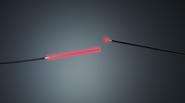
At the distal end, the output element turns transmitted laser or LED light into the emission profile required by the application. This may be a cleaved or structured bare-fiber tip, a tapered fused silica fiber as well as a glass- or polymer-based diffuser.
The geometry is engineered to deliver light forward, radially or along a defined length, with the specified intensity distribution at the treatment site. The aim is not simply to maximize scattering, but to generate a reproducible output matched to the treatment protocol and device geometry.
SCHOTT offers a range of medical-grade light delivery assembly solutions designed for optical efficiency, precise emission control and scalable manufacturing:
- fused silica-based fiber tips
- advanced glass-based diffuser solutions
- polymer-based assemblies
- fiber tapering, fiber-end structuring and coatings available on demand.

Why co-develop with SCHOTT?
From optical components to integrated laser delivery solutions
Medical laser devices rely on a complex optical path in which source coupling, fiber selection, light shaping and delivery system design must work together as an integrated system. With more than 60 years of experience in medical fiber optics, SCHOTT combines expertise in optical system engineering, laser diffuser design, and precision manufacturing. Working closely with medical device manufacturers, we develop solutions that balance optical performance, manufacturability, and regulatory requirements.From feasibility studies and prototyping to qualification and serial manufacturing, our application engineering teams support customers throughout the product lifecycle. A strong focus on design for manufacturability helps accelerate development and ensure a smooth transition from prototype to serial production.
FAQs
A fiber assembly is a custom-engineered optical fiber subsystem designed for integration into a medical device. Typical assemblies include fused silica optical fiber, connectors, protective tubing, strain-relief elements and customized emission features such as laser diffusers or laser fiber probes. These assemblies are optimized for the specific wavelength, power level and mechanical requirements of the medical application.
A laser diffuser – also referred to as an optical fiber diffuser or diffusing fiber tip – is a device that converts guided laser light into a controlled emission profile. Instead of emitting light only in a forward direction, diffusers distribute light uniformly over a defined area, such as radially (360°), cylindrically, or in a forward-directed pattern. This controlled light scattering enables homogeneous irradiance at the treatment site, which is critical for consistent and effective medical therapies.
A laser delivery fiber (optical fiber) transmits laser light from the source to the application site with minimal loss. These delivery fibers are also called bare fibers and have a mechanically shaped fiber tip. A laser diffuser, on the other hand, modifies the emission of that light at the distal end of the fiber. While standard fibers deliver a focused beam, diffusers create defined and homogeneous light distributions, enabling applications that require uniform irradiance rather than point illumination.
Uniform or homogeneous radiation or irradiance ensures that the delivered light energy is evenly distributed across the target tissue. This is critical in therapies such as photodynamic therapy (PDT) or laser interstitial thermal therapy (LITT), where uneven light distribution can lead to under- or overexposure. Homogeneous irradiance reduces hot spots, improves treatment reproducibility, and helps achieve consistent clinical outcomes.
Laser fiber diffusers are used in a wide range of medical applications, including:
- Photodynamic therapy (PDT) and photoimmunotherapy (PIT)
- Laser interstitial thermal therapy (LITT)
- Endovenous laser treatment (EVLT)
- Antimicrobial photodynamic therapy (aPDT)
- Intracavitary and endoscopic illumination
- Dermatology and aesthetic treatments
These applications require controlled and uniform light delivery in confined or sensitive environments.
Laser diffusers are available in several emission geometries, depending on the application:
- Cylindrical diffusers (radial emission along a defined length)
- Spherical or 360° diffusers
- Front-emitting diffusers
- Custom-shaped emission profiles
The choice of geometry depends on factors such as treatment area, cavity shape, and required irradiance distribution.
Laser diffusers can be manufactured from different materials, depending on performance requirements:
- Polymer optical fibers (POF) for cost-sensitive or lower-power applications
- Glass-based solutions (e.g., fused silica or specialty glass) for higher power, precision, and stability
Glass-based diffusers, such as SCHOTT® Luminous, offer advantages in optical efficiency, durability and reproducibility.
Laser light is coupled into an optical fiber through a carefully designed interface between the laser source and the fiber input. Key parameters include wavelength, beam profile, numerical aperture, and alignment precision. Efficient coupling maximizes usable optical power and minimizes losses, which is especially important in high-power medical laser systems.
The most common fiber type is fused silica fiber, which offers high transmission, excellent power handling, and biocompatibility. For extended wavelength ranges, such as mid-infrared applications (~3 µm), specialty fibers such as polycrystalline fibers may be used. The choice depends on the laser source and clinical application.
Key performance factors include:
- Coupling efficiency at the source
- Optical transmission losses in the fiber
- Fiber geometry and numerical aperture
- Emission profile of the diffuser
- Irradiance distribution at the target
- Thermal management and power handling
Optimizing these parameters together is critical for achieving reliable and effective system performance.
Yes, laser diffusers or laser fiber probes can be customized in terms of length, diameter, emission profile, and geometry to meet specific application requirements. Customization is often necessary for integration into medical devices such as catheters or endoscopes, where space constraints and defined illumination zones must be considered.
Laser fibers and diffusers are typically integrated into assemblies that include connectors, protective coatings, and mechanical interfaces. These assemblies must be compatible with device designs such as catheters or probes and withstand sterilization processes, handling, and clinical use conditions while maintaining consistent optical performance.
Glass-based laser diffusers offer several advantages:
- High optical efficiency
- Stable and reproducible emission profiles
- High power handling capability
- Compatibility with a wide wavelength range
- Robustness under thermal and mechanical stress
These properties make them particularly suitable for demanding medical applications requiring reliable and scalable performance.
SCHOTT supports OEMs across the full development process, from concept and optical design to prototyping and high-volume manufacturing. This includes fiber selection, coupling optimization, diffuser development, and system-level integration, enabling tailored solutions for specific medical applications.